

Your Brain on Creatine
The Emerging Science Behind This Supplement for Cognitive Health and Long COVID

For decades, creatine’s story began and ended with muscles. But the narrative is shifting. Researchers are now looking beyond muscle to a different energy-hungry tissue: the brain.
Believe it or not, this 3 pound organ consumes nearly a fifth of the body’s total energy. That heavy workload depends on rapid, reliable energy turnover, and creatine plays a major part in that system.
As promised in my last creatine article, here we’re zooming in on what creatine actually does in the brain—and why this matters for cognitive health and long-COVID recovery.
What is Creatine?
Creatine is a naturally occurring compound made from amino acids, the building blocks of protein. While your liver, pancreas, and kidneys produce about one gram per day, you also get creatine from foods like meat and fish.
Its role is simple but fundamental: creatine helps your cells regenerate energy quickly.
The cells in your body run on ATP (adenosine triphosphate), the molecule that powers nearly every biological process. But during moments of high demand, this energy is used up quickly. Creatine steps in to help replenish ATP when it’s being burned rapidly—whether during intense exercise, difficult cognitive tasks, stress, sleep deprivation, or even chronic illness.
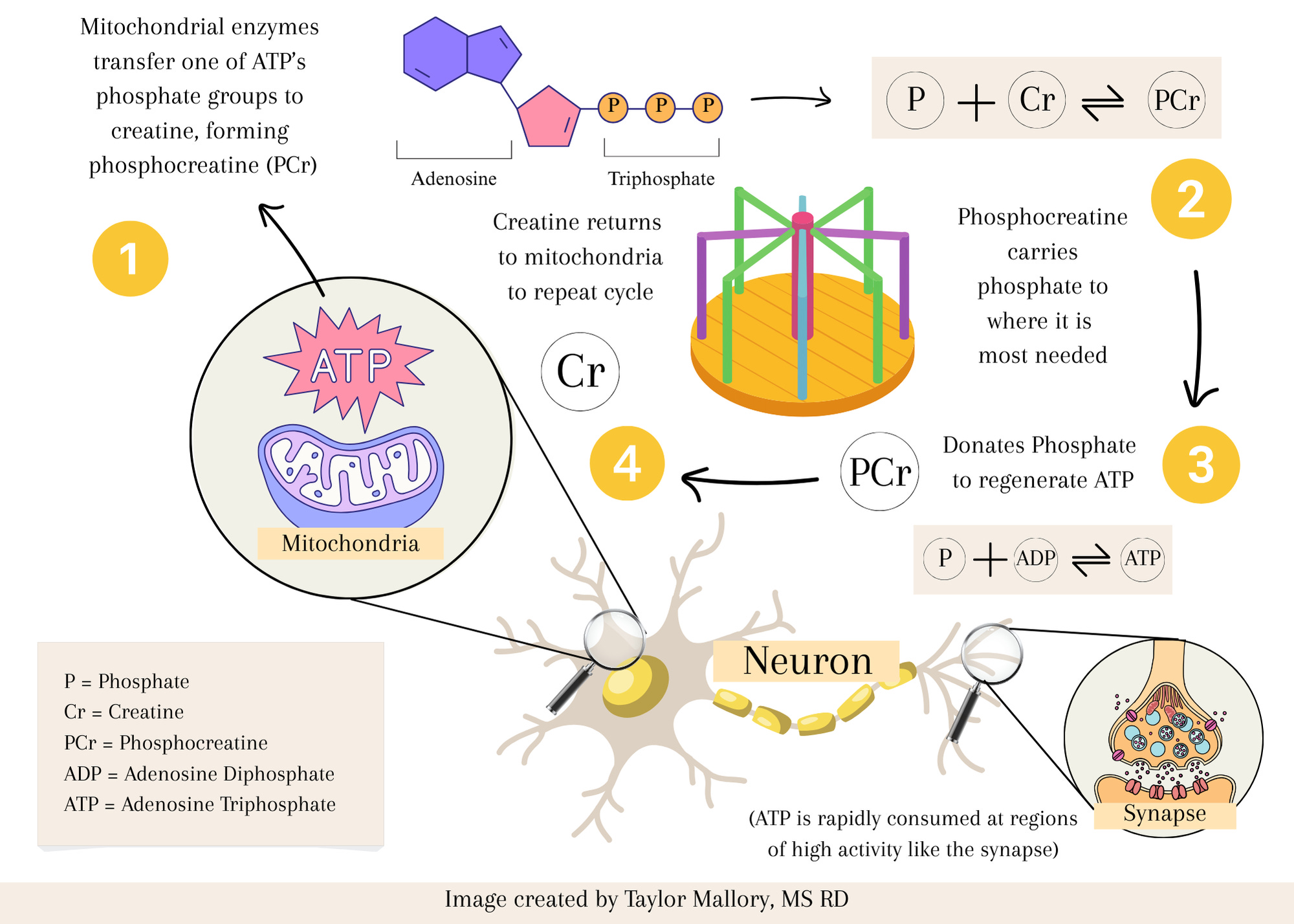
To understand why creatine matters so much for the brain, it helps to look at how this energy hand-off works inside a neuron (brain cell).
The Brain’s Energy Merry-Go-Round
Inside neurons, creatine helps ensure energy is available where it’s needed most.
Mitochondria attach a phosphate group (a type of energy carrier) to creatine, forming a compound called phosphocreatine. This compound then travels to active parts of the cell where ATP is being used rapidly, and donates the energy-rich phosphate to quickly recharge ATP.
Researchers have compared this to a cellular merry-go-round: phosphate groups “hop on” creatine at the mitochondria, “ride” to regions of high demand, “hop off” to help remake ATP, then the creatine returns for another turn.
This cycle gives neurons the flexibility to handle sudden increases in energy demand, which helps keep cognitive processes running smoothly.
The image below shows a detailed breakdown of this mechanism:
A similar mechanism also occurs in the muscles. If you would like to read an overview of creatine and ATP recycling in the muscle, you can read my article here:

Creatine & Cognitive Health
Now that we’ve dug into the mechanics of how creatine supports energy metabolism in the brain, let’s look at what the research says about how this reflects in real-world examples. A recent 2024 meta-analysis brought together human trials looking specifically at creatine’s effects on cognition, and the results were fascinating.
The meta analysis indicates that creatine supplementation had significant positive impacts on:
Attention
Memory performance
Processing speed
But what stood out most to me was this:
Creatine’s cognitive benefits were significantly stronger in people with illness than in healthy adults.
In healthy participants, creatine had small or inconsistent effects on cognitive function. But in individuals with illnesses including neurodegenerative diseases, the effect size was meaningful and statistically significant.
This matters because it suggests that creatine may be most supportive in contexts where energy metabolism is already struggling—when neurons are under more physiological stress and ATP turnover is less efficient.
Why Does Creatine Affect Cognition?
A closer look at the biology gives us some clues. Creatine’s role in cognitive health seems to tie back to a few core mechanisms that directly influence how efficiently neurons can work, especially under stress.
1. It boosts rapid energy availability
Creatine increases the brain’s supply of phosphocreatine (PCr)—that fast-access energy donor which helps maintain ATP levels during demanding cognitive tasks.
2. It supports neurotransmitter synthesis
Creatine participates in the production of neurotransmitters like acetylcholine, which is essential for attention, processing, and memory formation.
3. It may enhances synaptic efficiency and plasticity
Early research suggests creatine may function as a neuromodulator, supporting how effectively neurons communicate and adapt—the foundation of learning and memory.
4. It offers neuroprotective support
Creatine may also help the brain stay resilient during periods of metabolic stress—things like inflammation, sleep loss, aging, neurological conditions, or post-viral dysfunction. When neurons burn through ATP faster than they can replace it, they become more vulnerable to oxidative stress and cellular damage.
Since creatine helps keep energy turnover more stable, early research in areas like traumatic brain injury, aging-related cognitive changes, and neurodegenerative conditions suggests it may reduce energy deficits and support cellular resilience. The findings aren’t conclusive yet, but the pattern is interesting: individuals with chronic illness tend to see greater cognitive benefits than healthy adults, hinting that creatine’s support may matter most when the brain is enduring stress.
Creatine and Long-COVID
Long-COVID places an unusually heavy metabolic load on the brain, and emerging research suggests this ongoing stress may actually deplete the brain’s creatine stores, making it harder for neurons to maintain steady energy production. Supporting this idea, a recent study found lower creatine levels in both muscle and brain tissue among people with long-COVID compared to healthy controls.
Normally, the brain is more resistant to taking up creatine than muscle, which can make supplementation for cognitive symptoms less straightforward. Interestingly, a 2023 study found that participants with post-COVID fatigue who took four grams of creatine monohydrate daily showed a larger increase in brain creatine levels than what has been reported in studies of other neurological conditions—even though those studies often used higher doses.
This suggests a possible disease-driven susceptibility of the brain in people with post-COVID fatigue to absorb creatine more efficiently. One proposed mechanism is a dysregulation of the blood–brain barrier following COVID-19 infection, which may allow more creatine to enter the brain and help offset deficits seen in this condition.
Furthermore, the study found that creatine supplementation was associated with measurable improvements in some clinical features related to brain function. As brain creatine levels increased, participants reported a 77.8% reduction in concentration difficulties at three months and complete resolution by six months.
Researchers suspect the benefits arise from creatine’s combined roles: supporting ATP recycling, buffering cellular energy during stress, and offering anti-inflammatory, antioxidant, and neuromodulatory effects—all areas commonly disrupted after viral illness.
Wrapping Up
If you’ve found your way here, maybe you’re navigating lingering symptoms, supporting someone you love, or simply curious about emerging research related to the brain. Creatine sits at a really interesting intersection of all of this: an area of science that’s expanding quickly, with implications for cognitive health and long-COVID recovery.
It isn’t meant to replace the foundations of health like a nutritious diet, quality sleep, proper stress management, or personalized strategies tailored to your condition. But it may lend a helping hand to an overworked system—a small shift that, for some people, can make a noticeable difference.
I believe it did for me in my long COVID journey.
Medical Disclaimer
This information is for educational purposes only and is not intended as professional medical advice. Always consult your healthcare provider before taking creatine, combining it with any medication, or before making changes to your treatment or lifestyle.
Thank You for Your Support!
My goal is to keep my work free and accessible to the chronic illness community. Living with chronic conditions can be financially draining, and for many of us who are partially or fully disabled, accessing support and care can feel out of reach.
I have recently enabled the paid subscriber feature, but will never paywall my work. This is simply for anyone who has the means to contribute and would like to support financially. Or if you’ve found this article to be helpful, I’ve set up a Buy Me a Coffee page—a virtual tip jar where you can make a small donation if you’d like.
Your support helps make it possible for me to continue pouring time, research, and lived experience into creating these resources.
Whether you’re able to contribute or not, I’m so grateful you’re here. Thank you for being part of this community. 💛

Ive been using it for a few months and sadly have noticed no improvement :/
I put it in my coffee and have no problems. My husband uses the strawberry watermelon flavoring drops. We just get it in - we are both mid 50’s and need the protein